Looking for free days out in North Wales: Castles, a Neolithic tomb and hidden heritage open their doors this September. Are these the perfect family days out? They very well might be, after all, who doesn’t love a castle?
Once a year, some of Wales’ most guarded historic buildings let their guard down. Cadw’s Open Doors festival returns this September, offering free entry to hundreds of locations across the country as Wales’ contribution to the wider European Heritage Days initiative. In North Wales, the 2026 programme takes in medieval fortresses, a Tudor gentry house with a claim to the birthplace of modern Welsh, a 5,000 year old burial chamber and a Victorian prison, several of which stay firmly closed for the rest of the year.
Dr Ffion Reynolds, Cadw’s Senior Heritage Events and Arts Manager, put it simply: Open Doors gives people the chance to “explore the extraordinary heritage on their doorstep and discover places they may have never visited before.” This year’s programme, she added, includes “many unique experiences, from behind the scenes access and guided tours to opportunities to visit places that are rarely open to the public.”
Denbigh Castle
Edward I did not take betrayal well. Denbigh Castle rises on the site of Dafydd ap Gruffudd’s own royal residence, a llys the English king had it torn down after Dafydd, once an ally, rose against him in 1282. The lordship passed to Edward’s commander Henry de Lacy, with orders to build a fortress and a walled English town over the ruins, part of the iron ring of castles thrown up to keep North Wales subdued, alongside Conwy, Caernarfon, Harlech and Beaumaris.

It was not a smooth build. Welsh forces under Madog ap Llywelyn captured the half finished castle during the 1294 uprising, and it took de Lacy a year to win it back, after which the builders switched stone part way through, so the two phases of work are still visible in the walls today. The triple towered gatehouse, probably designed by Edward’s master builder James of St George, remains the castle’s most dramatic feature. Denbigh went on to see out the Wars of the Roses and a six month Civil War siege under the Royalist Colonel William Salesbury before being deliberately slighted in 1659.
The castle opens free on 19th and 20th September, 10am to 5pm, with guided tours of the gatehouse and curtain walls plus family activities, workshops and talks.
The full list of participating Open Doors sites can be found here.
Dolbelydr
This one is genuinely hard to see. Tucked into a quiet valley near Trefnant, Dolbelydr is a 16th century gentry house, built around 1578, that spends almost the entire year closed to visitors. It owes its place in Welsh history to Henry Salesbury, a Denbigh physician who wrote his Grammatica Britannica here in 1593, one of the first attempts to set down a formal grammar for the Welsh language at a time when English was being pushed as the language of government under the Tudors. It is a serious claim to fame for such a modest house: some call it, not unreasonably, the birthplace of modern Welsh.
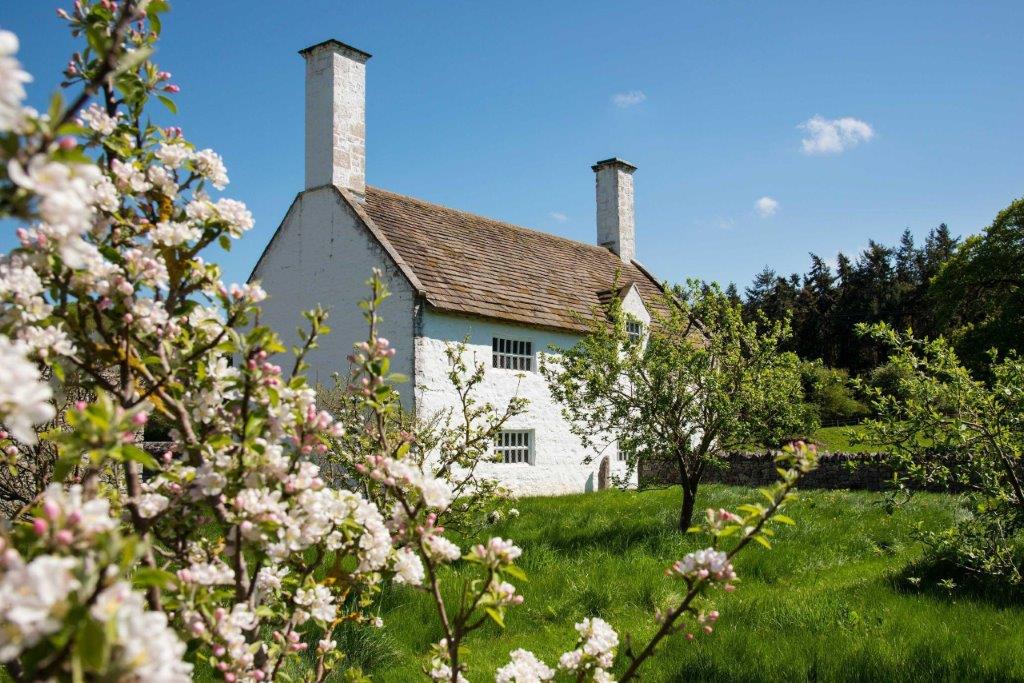
Now cared for by the Landmark Trust, Dolbelydr has survived remarkably unaltered, with its original spiral staircase, tall chimneys and a first floor solar open to the roof beams all restored to the form Salesbury would recognise.
Doors open on 19th and 20th September, 10am to 4pm, with the chance to see inside and hear about the restoration.
Castell Harlech
Few Welsh castles hold a view like Harlech’s, perched on its crag above Tremadog Bay with the mountains of Eryri behind it, and few carry as much weight of history. Built between 1283 and 1289, again to James of St George’s design, it forms part of the Castles and Town Walls of King Edward in Gwynedd, a UNESCO World Heritage Site since 1986.
Its defining moment came in 1404, when the Welsh rebel leader Owain Glyndŵr took the castle and made it his base for the next four years, holding court and, by tradition, a Welsh parliament there while envoys arrived from Scotland, France and Spain. It was the closest Wales came to functioning as an independent state under its own prince. The English retook Harlech in 1409, and the castle later endured a seven year siege during the Wars of the Roses, said to be the longest in British history and the origin of the song Men of Harlech.
Free guided tours with Siân Roberts run on 26th and 27th September, 11am to 4pm.
Barclodiad y Gawres
Long before any castle, there was this. On a windswept headland above Porth Trecastell on Anglesey sits Barclodiad y Gawres, the giantess’s apronful, a Neolithic passage tomb dating to around 3,000 to 2,500 BC. Its design, a cruciform chamber reached along a narrow passage, is far more common in Ireland than in Britain, most famously at Newgrange, and points to close contact between Neolithic communities on both sides of the Irish Sea.
Excavations in 1952 and 1953 found five stones inside carved with spirals, chevrons and zigzags, echoing Irish passage tomb art, alongside burials and traces of what looks like ritual activity, including a fire on which a stew of fish, frogs and small mammals had been cooked. A sixth, fainter carving was identified as recently as 2001. The chamber sits under a modern concrete dome, with the earth and turf mound recreated above it.
Open Doors gives rare access to the decorated stones on 13th and 27th September, 11am to 4pm.
Rug Chapel
Plain outside, riotous within. Rug Chapel, built in 1637 near Corwen for Colonel William Salesbury, the same Royalist who later held out at Denbigh Castle for six months, gives nothing away from its exterior. Salesbury, nicknamed Hen Hosanau Gleision, or Old Blue Stockings, had firmly High Church tastes, and inside almost no surface escapes decoration: carved angels, a richly painted timber roof and elaborate woodwork, in deliberate defiance of the plainer style favoured by Puritans of his day.
It is one of very few 17th century chapels never touched by Victorian restorers, so what visitors see is close to what Salesbury knew. He lived to 80, long enough to see the monarchy restored in 1660.
A free guided tour runs on 26th September at 2pm.
Ruthin Gaol
A house of correction has stood on this Ruthin site since 1654, but the building most visitors picture dates from 1775, designed by the architect Joseph Turner, with a grim four storey wing added in 1866 on the Pentonville model, built to hold a hundred prisoners in isolation and set them to repetitive labour. The gaol closed in 1916, and the buildings went on to serve as everything from a wartime munitions factory to council offices.
Today the cell blocks share the site with the North East Wales Archives, whose strongrooms hold documents stretching back to the 12th century, a striking pairing of Victorian punishment and centuries of paperwork under one roof. Open Doors visitors can go behind the scenes to see how those records are preserved, on 12th September, 12.30pm to 3pm.
Planning Your Visit
Booking requirements vary between sites, so check individual event listings on Cadw’s Open Doors website before setting off. The full programme, with every participating venue and date across Wales, is at www.cadw.gov.wales
Travel Life Tips!
* Pair nearby sites into one day out. Denbigh Castle and Dolbelydr are a short drive apart in Denbighshire, while Castell Harlech and Barclodiad y Gawres can be combined with a scenic run along the Llŷn and Anglesey coast.
* It is a fair distance from South Wales, so an early start pays off if you want to fit in more than one site.
* Wear sturdy shoes. Castle ruins and clifftop passage tombs both mean uneven ground, even on well maintained paths.
* The Ruthin Gaol archive tour and the Rug Chapel guided tour both run for a short, fixed window, so arrive in good time.
* Denbigh has more listed buildings than any other town in Wales, so leave time to explore the town alongside the castle.
* Harlech and Anglesey both have beaches close to their historic sites, handy for pairing heritage with a walk if the weather holds.
…
Travel Life’s sister sites in Wales
Travel Life has several sister magazines in Wales, especially South Wales.
* If you’re in Cardiff, Wales’ capital city, you can find out more at www.citylifecardiff.co.uk
* Visiting the beautiful Vale of Glamorgan, Wales’ most southerly county, then www.valelife.co.uk is the website for you.
* The legendary Gower Peninsula and Swansea can be found at www.gowerlife.co.uk
* For Carmarthenshire and Pembrokeshire, click on www.westlifemag.co.uk
Remember there’s a lot more to Wales, especially North Wales.
…